How Inflation Affects Your Savings (And How to Beat It)
Imagine you worked hard for a month and earned $1,000 (or ₹50,000, or £800). You decide to be responsible and lock that money away in a safe deposit box in your closet. You feel secure knowing your money is safe.
Ten years later, you open the box. The money is still there—the exact same number of notes. But when you take that money to the grocery store, the petrol station, or try to pay your rent, you realize something terrifying: it buys significantly less than it used to.
Who stole the value of your money without touching the physical cash? The culprit is an invisible economic force called inflation. Often dubbed the "silent thief," inflation is the reason why keeping your long-term savings in cash or a standard low-interest bank account is practically guaranteed to make you poorer over time.
Whether you live in the USA, the UK, or India, understanding inflation isn't just for economists—it's essential for your financial survival. This guide will explain exactly how inflation erodes your wealth and, more importantly, give you actionable strategies to fight back.
What Is Inflation, Anyway?
In the simplest terms, inflation is the rate at which the general level of prices for goods and services is rising. Consequently, it is the rate at which purchasing power is falling.
Think about your daily life. The cost of a loaf of bread, a liter of fuel, a haircut, housing rent, and medical care tends to creep up year after year. When prices rise, every unit of currency you own buys a smaller percentage of a good or service.
Why Does It Happen?
Economists debate the exact causes, but it generally boils down to a few key factors:
- Demand-Pull Inflation: This is often described as "too much money chasing too few goods." If everyone wants to buy a new car, but factories can't produce them fast enough, the price of cars goes up.
- Cost-Push Inflation: If the cost of raw materials (like oil or steel) or labor increases, businesses raise their prices to maintain their profit margins. We saw this globally post-pandemic due to supply chain disruptions.
- Monetary Policy: Sometimes, when central banks print more money to stimulate the economy, it can decrease the value of the existing money in circulation.
The "2% Target": Why Governments Want Small Inflation
You might wonder: why don't central banks aim for 0% inflation? Most central banks (like the US Federal Reserve or the Bank of England) aim for a 2% annual rate. This is seen as a "Goldilocks" level—high enough to encourage people to spend and invest (since money loses value slowly), but low enough to avoid a massive cost-of-living crisis.
The Hidden Metric: Your "Personal Inflation Rate"
The official inflation rate (measured by the Consumer Price Index or CPI) is a national average. However, your individual experience might be much worse.
Why your rate differs:
- Housing: If you are renting or looking to buy, your inflation rate is tied to the housing market, which often outpaces the CPI.
- Lifestyle: If you travel frequently, you are more affected by aviation fuel prices and hotel rates.
- Geography: Costs in London, New York, or Mumbai rise significantly faster than in rural areas.
To effectively protect your savings, you must calculate your own personal inflation based on your actual spending basket, not just the news headlines.
The "Silent Thief": How It Erodes Your Savings
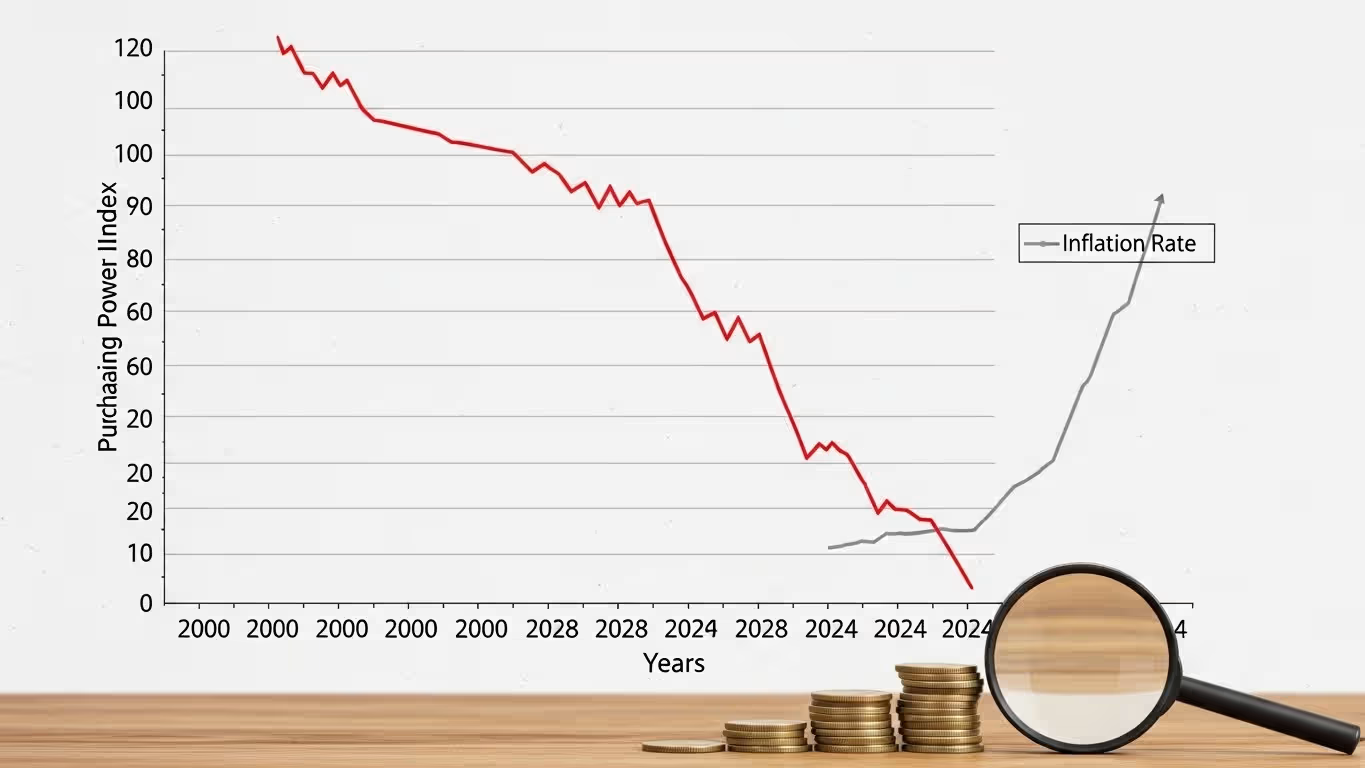
The most damaging aspect of inflation isn't just that things cost more; it's that your accumulated savings become worth less. This is the concept of Purchasing Power Erosion.
Let's look at a practical example. Suppose the annual inflation rate is consistent at 5%.
The $100 Shopping Cart Example
Today, $100 fills your grocery cart to the top.
Next year, with 5% inflation, that same cart of groceries costs $105. Your $100 bill no longer buys the whole cart.
In roughly 14 years at a 5% inflation rate, your $100 will only buy half a cart of groceries. The numerical value of your money didn't change, but its real-world value was cut in 50%.
This is why inflation is so dangerous for retirees or anyone saving for a long-term goal (like a child's education 15 years from now) using only cash savings. You might hit your numerical savings target, only to find it doesn't cover the costs you planned for.
The Savings Account Trap: The "Real Rate of Return"
Many people believe they are being financially prudent by keeping all their money in a standard bank savings account. After all, it earns interest, right?
Yes, but you have to look at the Real Rate of Return. This is the interest rate you earn minus the rate of inflation.
- Scenario A (The Good Old Days): Your bank pays 5% interest. Inflation is 2%. Your real return is a positive +3%. Your wealth is growing.
- Scenario B (The Current Reality for Many): Your bank pays 1% interest (common in the USA/UK for standard accounts). Inflation is running at 4%. Your real return is a negative -3%.
In Scenario B, by leaving your money in the bank, you are actively losing 3% of your purchasing power every single year. A standard savings account is excellent for an emergency fund (liquidity is important), but it is terrible for long-term wealth preservation.
How to Fight Back: Moving from Saving to Investing
To beat inflation, you cannot just *save* money; you must *invest* it. Your goal is to put your money into assets that have historically grown faster than the rate of inflation over long periods. Here are the primary strategies:
1. Equities (Stocks & Mutual Funds)
Historically, investing in the stock market has been one of the most effective ways to outpace inflation over long periods (10+ years). Companies can raise their prices to cope with inflation, leading to higher revenues and eventually higher stock prices.
Examples: Investing in low-cost index funds that track the S&P 500 (USA), FTSE 100 (UK), or Nifty 50 (India). While volatile in the short term, they tend to beat inflation significantly long-term.
2. Real Estate
Real estate is a "hard asset" with intrinsic value. During inflationary times, property values and rental income tend to rise. Landlords increase rent to match rising costs, providing a natural hedge.
This could involve buying a rental property or investing in REITs (Real Estate Investment Trusts) if you prefer a more hands-off approach.
3. Inflation-Protected Bonds
Some governments issue bonds specifically designed to protect against inflation. The principal value of these bonds adjusts based on the official inflation rate.
Examples: TIPS (Treasury Inflation-Protected Securities) in the USA, or Index-linked Gilts in the UK. These offer lower returns than stocks but provide guaranteed protection for the cautious portion of your portfolio.
Conclusion: Inaction is Expensive
Inflation is an inevitable part of a modern economy. Ignoring it won't make it go away; it will only make you poorer over time.
The takeaway is clear: leaving large amounts of long-term savings languishing in a low-interest bank account is a guaranteed losing strategy. While you need some cash for emergencies, the bulk of your future wealth—for retirement, education, or legacy—needs to be put to work.
By shifting your mindset from "saving" to "investing," and choosing assets like diversified equities, real estate, or inflation-linked bonds, you can ensure that your hard-earned money keeps up with the rising cost of living and actually grows in real value.
Frequently Asked Questions
Is gold a good hedge against inflation?
Should I invest my emergency fund to beat inflation?
What is Hyperinflation? ↓
Are Index Funds a safe bet against inflation? ↓
What is a "high" inflation rate?
Don't Let Inflation Win.
Stop guessing how much your future savings will be worth. Use our calculators to account for inflation and plan your investments accurately.